
If you have been trying to finance rental properties or commercial deals through a traditional lender, you have probably run into walls. Strict income documentation, DTI limits, and caps on how many mortgages you can carry all work against active investors. That is where non QM loans come in.
At REIF Loans, we work with investors every day who need flexible financing that matches how they actually earn money and grow wealth. This guide breaks down what non-QM loans are, who they work best for, and what to consider before applying.
What Is a Non-QM Loan?
A non-QM loan, or non-qualified mortgage, is any home loan that does not meet the lending standards set by the Consumer Financial Protection Bureau (CFPB). After the 2008 financial crisis, the CFPB created rules defining what counts as a “qualified mortgage,” including specific debt-to-income ratios, income verification methods, and loan term restrictions.
Non-QM loans fall outside those guidelines, but that does not mean they are risky or subprime. It simply means the lender uses alternative methods to evaluate whether a borrower can repay the loan. Traditional QM standards were designed for W-2 earners buying a primary residence, not for someone managing a portfolio of income-producing properties.
How Non-QM Loans Differ from Traditional Mortgages
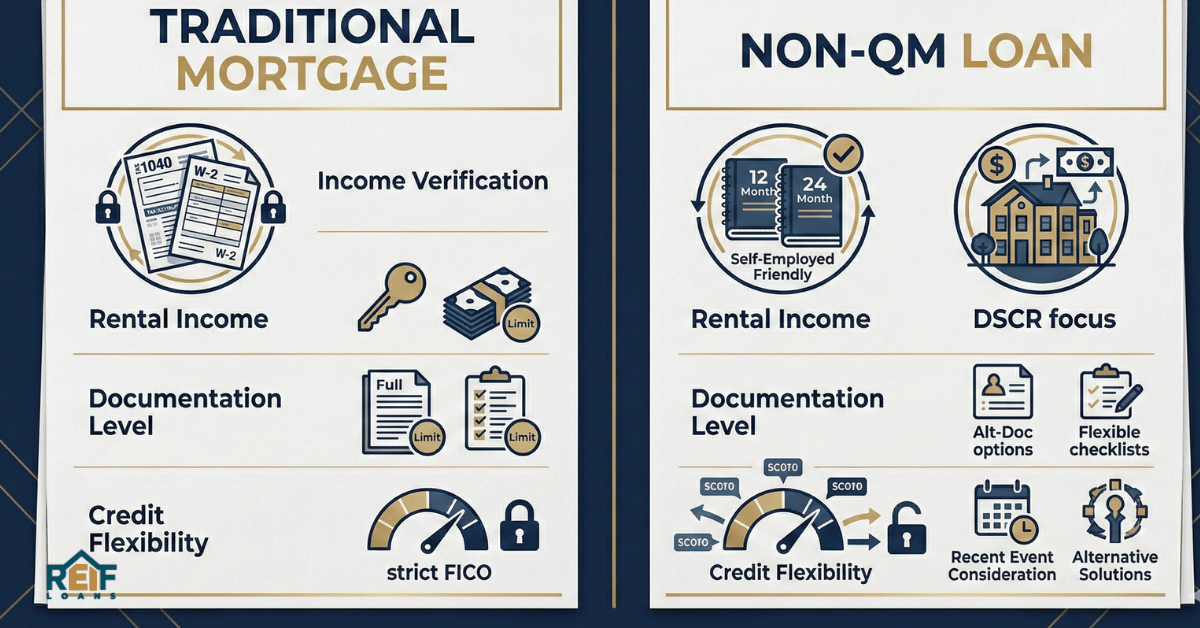
Traditional qualified mortgages follow rigid requirements that often become obstacles for investors scaling a portfolio. Here is how the two compare:
- Income verification: QM loans require W-2s and tax returns. Non-QM loans can use bank statements, asset documentation, or property cash flow instead.
- DTI limits: Qualified mortgages cap your debt-to-income ratio, which becomes a problem when you hold multiple properties. Non-QM lenders evaluate deals on a case-by-case basis.
- Property count limits: Conventional lenders typically cap financing at 10 properties. Non-QM lending has no such standard restriction.
- Closing speed: Traditional loans can take 30 to 45 days. Many non-QM products close significantly faster, which matters when competing for deals.
Types of Non-QM Loans Every Investor Should Know
Not all non-QM loans are the same. Depending on your investment strategy, certain products will make more sense than others.
DSCR Loans
With a DSCR loan, the lender qualifies you based on the property’s rental income rather than your personal income. If the property generates enough cash flow to cover the mortgage payment, you can qualify regardless of what your tax returns show. This is one of the most popular options for buy-and-hold investors and a core product that REIF Loans offers across Michigan and 43 states.
Bank Statement Loans
If you are self-employed or run business income through an LLC, your tax returns probably do not reflect your actual earning power. Bank statement loans use 12 to 24 months of bank statements to verify income, which works well for investors who write off significant expenses.
Hard Money and Bridge Loans
These short-term options are typically used for fix-and-flip or value-add deals. Hard money loans close in days rather than weeks and are secured by the property itself. Higher rates come with the territory, but the speed makes them essential for certain strategies.
Who Benefits Most from Non-QM Loans?
Non-QM lending fits a specific set of borrowers particularly well. You might be a strong candidate if you match one or more of these profiles:
- You are an investor with multiple financed properties who has hit conventional loan limits.
- You are self-employed and your tax returns understate actual income due to deductions.
- You are a foreign national investing in U.S. real estate without a traditional credit history.
- You want to qualify based on a property’s rental income rather than personal earnings.
REIF Loans specializes in working with these exact borrower profiles. Our team understands that an investor’s financial picture often looks very different from what traditional underwriting models are designed to evaluate.
What Are the Drawbacks of Non-QM Loans?
Interest rates on non-QM products are generally higher than conventional mortgage rates, reflecting the additional flexibility the lender provides. You may also face larger down payment requirements, typically 15% to 25% or more.
Some non-QM loans include prepayment penalties, so reading the fine print is important. Because underwriting standards vary between lenders, working with a specialist who focuses on investor lending makes a real difference.

Is a Non-QM Loan the Same as a Non-Conforming Loan?
Not exactly. A non-conforming loan does not meet Fannie Mae or Freddie Mac guidelines, which could simply mean the loan amount exceeds conforming limits. A non-QM loan specifically does not meet the CFPB’s qualified mortgage rules. There is overlap, but the terms are not interchangeable.
How to Get a Non-QM Loan
The process is more straightforward than most investors expect:
- Start with pre-qualification. A good lender will evaluate your situation quickly. REIF Loans offers fast pre-qualification designed specifically for investors.
- Gather documentation. Depending on loan type, this could include bank statements, asset verification, property appraisals, or rent rolls.
- Property evaluation. For DSCR loans, the lender analyzes the property’s income potential relative to the proposed mortgage payment.
- Underwriting and closing. Non-QM loans often move through underwriting faster because the evaluation criteria are more targeted.
Why Investors Choose REIF Loans for Non QM Financing
REIF Loans was built to serve real estate investors. Founded by Elizabeth Shvartsman, the company focuses on cash flow driven strategies across Michigan and 43 states. Whether you need a DSCR loan for a rental acquisition, a hard money loan for a flip, or a cash out refinance to pull equity, REIF Loans offers transparent terms and investor-first advisory.
When your lender understands investor financing and structures deals around your actual goals, you close faster and build smarter.
Frequently Asked Questions
Is a Non-QM Loan Bad?
No. Non-QM simply means the loan does not follow CFPB rules for qualified mortgages. These are legitimate products offered by licensed lenders. For many investors, non-QM loans are the best available option.
Can You Refinance Out of a Non-QM Loan?
Yes. Many investors use non-QM products as a stepping stone. You might use a hard money loan to acquire and renovate a property, then refinance into a long-term DSCR loan once the property is stabilized and generating rental income.
Do Banks Offer Non-QM Loans?
Some do, but most non-QM lending happens through specialized mortgage companies and private lenders like REIF Loans who have more flexibility in structuring and underwriting deals.