If you own rental properties or investment real estate, there is a good chance you are sitting on equity you could put to work. A cash out refinance lets you tap into that equity without selling the property, giving you capital to grow your portfolio or strengthen your financial position.
At Real Estate Investor Friendly Loans, we work with real estate investors across Michigan and 43 states who use cash out refinancing as a core part of their investment strategy. This guide breaks down everything you need to know before making your move.
What Is a Cash Out Refinance?
A cash out refinance replaces your current mortgage with a new, larger mortgage. The difference between what you owed on the old loan and the new loan amount gets paid to you in cash at closing.
For investors, this works a bit differently than it does for homeowners refinancing a primary residence. Lenders typically apply stricter terms on investment properties, including lower loan-to-value (LTV) limits and closer scrutiny of the property’s income potential. If you are working with a Real Estate Property DSCR loan through a lender like Real Estate Investor Friendly Loans, your rental income plays a central role in qualification rather than your personal W-2 income.
Can a Cash Out Refinance Be Used for Anything?
In most cases, yes. Once the funds hit your account, you have flexibility in how you use them. Investors commonly put cash out refinance proceeds toward:
- Purchasing additional investment properties to grow their portfolio
- Funding renovations or value-add projects on existing rentals
- Paying off hard money mortgage or other higher-interest short-term debt
- Building cash reserves for maintenance, vacancies, or unexpected expenses
- Covering closing costs on new acquisitions
There are no restrictions from most lenders on how you spend the funds after closing. That said, the smartest investors use this capital strategically, putting it into assets or improvements that generate additional returns over time.

How Much Money Can I Cash Out?
The amount you can pull out depends on your property’s current appraised value and the loan-to-value ratio your lender allows. For investment properties, most lenders cap LTV between 70% and 75%, which is lower than the 80% commonly available on primary residences.
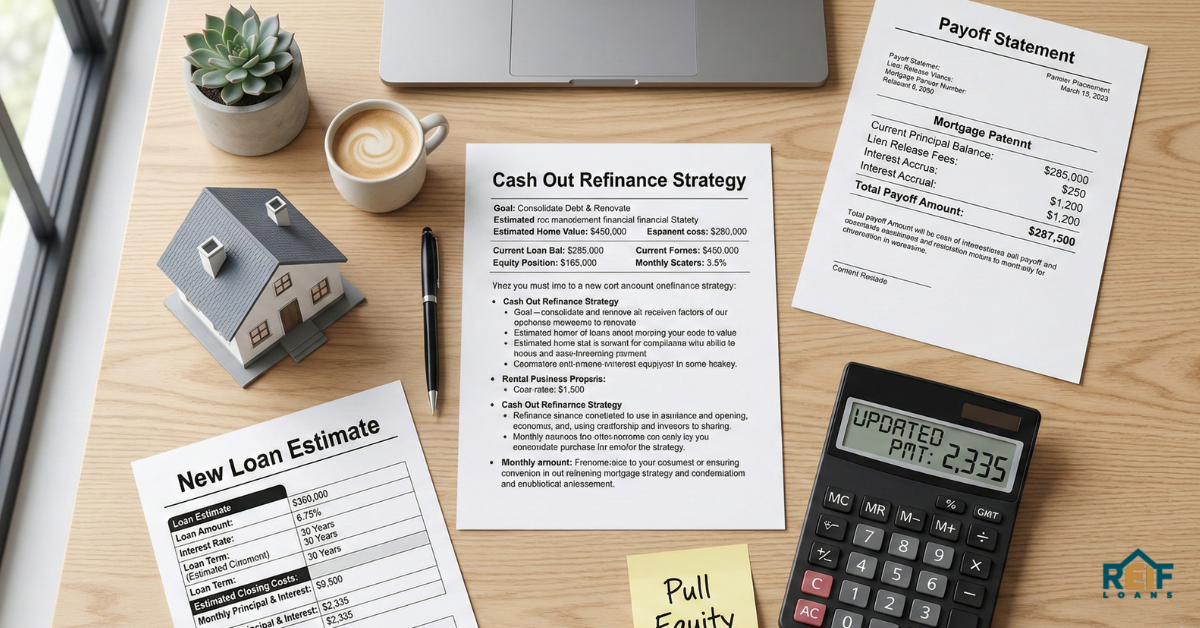
Here is a quick example. Say your rental property appraises at $400,000 and you still owe $240,000 on the existing mortgage. If your lender allows 75% LTV, your new mortgage could be up to $300,000. After paying off the $240,000 balance, you would receive $60,000 in cash (minus closing costs).
How to Calculate Loan-to-Value Ratio (LTV)
LTV is one of the most important numbers in any refinance. The formula is simple:
LTV = (Loan Amount / Appraised Property Value) x 100
So if you are borrowing $300,000 on a property worth $400,000, your LTV is 75%. Lenders use this ratio to assess risk. The lower your LTV, the more favorable your terms tend to be. If your property has appreciated significantly since you bought it, you may have more equity available than you think.
Is My Monthly Mortgage Payment Going to Change?
Yes, it almost certainly will. Because you are taking out a larger mortgage than what you previously owed, your monthly payment is going to increase. How much it changes depends on several factors:
- The new mortgage amount compared to your previous balance
- The interest rate on your new mortgage versus the old one
- The mortgage term you choose (30-year, 15-year, etc.)
- Property taxes and insurance if those are escrowed into the payment
In some cases, if interest rates have dropped since your original mortgage, the rate improvement can partially offset the higher balance. But in most scenarios, expect a higher monthly obligation. Run the numbers carefully and make sure your rental income still covers the new payment comfortably.
Cash Out Refinance Requirements
Qualifying for a cash out refinance on an investment property involves meeting several criteria. Here is what most lenders look for.
What Is the Minimum Credit Score for a Cash Out Refinance?
Most conventional lenders want to see a credit score of at least 680 for investment property cash out refinancing. Some programs require 700 or higher. At Real Estate Investor Friendly Loans, we work with investors across a range of credit profiles through our DSCR and Real Estate Property Non-QM Loans programs, so requirements may be more flexible than what traditional banks offer.
What Is the Maximum Debt-to-Income Ratio?
For conventional mortgage, lenders typically want your DTI below 45%. However, with Real Estate Property DSCR Loans, the focus shifts from your personal debt-to-income ratio to the property’s debt service coverage ratio. This means the property’s rental income needs to cover the mortgage payment, usually at a ratio of 1.0 or higher. This is a significant advantage for investors who hold multiple properties or have complex income situations.
Is an Appraisal Required for a Cash Out Refinance?
Yes. An appraisal is required in nearly every cash out refinance. The lender needs to confirm the property’s current market value to determine how much equity is available. For investment properties, appraisers also typically look at comparable rental rates in the area, which can influence DSCR-based lending decisions.
How Does a Cash Out Refinance Work?
The process follows a fairly predictable path from start to finish:
- Apply with your lender and provide documentation on the property and your financials
- Property appraisal is ordered to confirm current market value
- Underwriting review where the lender evaluates LTV, creditworthiness, and income (or DSCR)
- Mortgage approval and terms are locked including rate, fees, and closing timeline
- Closing day where you sign documents, the old mortgage gets paid off, and you receive your cash
How Long Does a Cash Out Refinance Take?
Expect the process to take anywhere from 21 to 45 days depending on the lender and how quickly the appraisal and documentation come together. Working with a lender that specializes in investor mortgage, like Real Estate Investor Friendly Loans, can often speed things up because the team already understands the nuances of investment property transactions.

Why Investors ChooseReal Estate Investor Friendly Loans for Cash Out Refinancing
Not every lender understands the needs of real estate investors. Many traditional banks are built around primary residence lending, which means slower timelines, rigid income requirements, and less flexibility for portfolio-minded borrowers.
Real Estate Investor Friendly Loans was founded by Elizabeth Shvartsman specifically to serve investors. Whether you hold single-family rentals, multifamily properties, or commercial real estate, the team at Real Estate Investor Friendly Loans offers Real Estate Property DSCR Loans, non-QM programs, and cash out refinance options designed around how investors actually operate.
Here is what sets Real Estate Investor Friendly Loans apart:
- Fast pre-qualification so you can move quickly when opportunities come up
- DSCR-based lending that focuses on property cash flow instead of personal income
- Coverage across Michigan and 43 states for investors building portfolios in multiple markets
- Transparent terms with no hidden fees or last-minute surprises at closing
If you are ready to put your equity to work and take the next step in growing your investment portfolio, reach out to Real Estate Investor Friendly Loans today for a consultation. The team is ready to walk you through your options and help you find the right financing solution for your goals.